
The Red Rosettes and the Song as Performance Guide

redrosettesWednesday night took up to Preston to spend an evening working with the Red Rosettes. In many ways it felt like a classic evening's coaching for me in its focus on exploring the musical material of the song and arrangement as a route to understand its emotional and narrative shape.

We started off by playing with different styles of rhythmic characterisation (discovering a preference in this instance for sling swing and stretch swing), and as so often happens, as soon as the rhythmic feel came into focus, all sorts of other performance details became both more interesting and better executed throughout the chorus. Clarity in musical shape produced better technical control and a more distinctive performance persona.

Calling all Arrangers!

It’s time to start the 2012-13 cycle of the Mutual Mentoring Scheme for Arrangers. For those who haven’t participated before (and indeed those who have but who want to refresh their memories of how it works) there’s an overview here.

The timescale for launching this year's cycle is as follows:

Please let me know by 30 September if you’d like to participate this year. I will then be in touch to introduce you to your partner by 14 October.

I've heard from several people during the year that they'd like to participate in the next cycle - please confirm, though, that you're definitely in. I wouldn't wish to assume either way! And likewise, for people who have participated in any of the previous cycles, let me know whether you're in or out for 2012-13.

I've also heard from several people that they have friends who might be interested - now is the moment to send this link to those friends!

I look forward to hearing from you over the next couple of weeks.

Why it’s Harder to Win Over an Audience in Cabaret-Style Seating

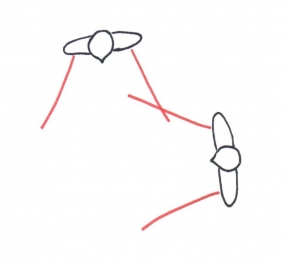
The F-formationThe F-formationAs I mentioned a few months ago, my recent adventures in stand-up comedy have been giving me all kinds of new insights into the performance-audience dynamic. Some of the experiences are no doubt peculiar (in both senses) to the genre, but at the same time they shed light onto things I had previously half-analysed but not fully understood.

Heckling is pretty firmly in the category of ‘peculiar to stand-up’. Indeed, if you are short of things to entertain you on a long train journey, I can recommend speculating about what form a heckle might take at a recital of Mozart piano sonatas. (That thought lasted me halfway from Durham to Darlington.)

But sitting towards the back of a crowded room at the comedy night at my local pub, I learned all kinds of things about audience-performer relationships from a rather drunk person who was determined to join in.

Norwich Harmony, and the Relationship between Voice and Imagination

norwichThursday saw me out East to coach Norwich Harmony at the start of the convention preparation season. They have been making significant strides in recent years in their consistency of control over matters of vocal production and unit sound, and it was interesting to hear how these efforts played out working on different parts of their repertoire.

To start with, there was a clear difference in technical control between a piece they have only recently learned and one that has been in their repertoire for a couple of years. It’s one of the endless dilemmas in developing a chorus that, while keeping songs in the repertoire for longer gives opportunities for depth of learning as familiarity with content frees up attention for other matters, at the same time, each song tends to act as a snap-shot of the skill level the singers had when it was first introduced.

Some Help in Harmonising...

I recently received an email with the subject line 'Please help me to harmonise', and I thought: well, yes, that's what I do! I'll let my correspondent say in her own words what in particular she'd like help with:

In January I took up singing in an A Cappella group. I find singing in a harmony group difficult at present and I am sure that it is all in my head.

I am singing baritone and have no problem at all learning my part, I sing well when I am grouped with the other baris in my group and we sound great as a unit. It's when we are split up and I end up having the lead part sung loudly in my ear, I just can't cope because all I can hear is the lead part... I would love to be able to hear the chord that all the parts make up to help me gel in this chorus.

Now my first thought is: don't be down-hearted, this is a perfectly normal experience in the first few months of singing a cappella harmony. One of the reasons I wanted to respond publicly was because there will be loads of other people saying either, 'Yes, that's me too!' or 'Yes, that was me when I first started!' So message number 1: hang on in there, this is something you do get better at over time.

Extreme Quartetting

I spent Saturday afternoon and evening in Nottingham at the British Association of Barbershop Singers’ Harmony College, at which I had been invited to judge the contest that formed part of a stream called ‘Extreme Quartets’. This is a model that takes the idea of chamber music as practice gadget, and simultaneously supports and intensifies the experience.

The way it works is this. Participants learn a great pile of music in advance (in this case, six songs), and then spend the weekend receiving coaching on them, both as a chorus – re-living the original invention of the barbershop chorus as a way to deliver coaching to lots of singers simultaneously – and in a variety of quartet line-ups. The contest had a preliminary round in the afternoon, with the top two quartets and a randomly-picked third going through to the final in the Saturday evening show.

Culture and Subculture; Identity and Rivalry

crazystrawsThe morning after the Olympics I heard a conversation on the radio about national and regional identities. It wandered through whether it was positive or divisive for people to be saying things like 'If Yorkshire were a country, we'd be 7th on the medal table', past how John Lennon's 'Imagine there's no countries' throws the whole concept of the Olympic Games in disarray, and ended with the cheering thought that, 'When the Martians land, that's when we can reasonably be separatist.'

The notion it developed without really naming was that of identities as nested. British people do this a lot as a matter of course: depending on context I may say that I'm British or I may say that I'm English. I've moved around enough that I don't tend to identify with a smaller granular level than that, though if I were a Yorkshirewoman or a Scouser I might carry that identification with me even as I moved round the country: it's clear that some regions and cities have a stronger tribal pull than others.

We do this in music all the time too of course.

Rehearsing, Performing and the Relationship with Time

timeparadoxI recently found myself leafing through a book called The Time Paradox that explores the question of people’s relationships with past, present and future. These relationships seem to consist of a combination of attention (is your imagination always leaping ahead to plans and projects yet to come, or wallowing in events that have already happened?), and emotional orientation (do you focus on the positive or negative aspects of the time you’re paying attention to?).

Lots of interesting stuff in there, of which possibly the most important for practical purposes is the typical profile of happy and well-adjusted people. This involves a strong orientation towards the positive past (traditions, happy memories, as opposed to regrets), and a reasonably strong orientation to both the hedonistic present (pleasure, living in the moment, as opposed to the fatalistic present in which you feel no control over your life) and to the future. They also have some useful lists of things to do to strengthen your connection with any of these if you’re out of balance.

...found this helpful?

I provide this content free of charge, because I like to be helpful. If you have found it useful, you may wish to make a donation to the causes I support to say thank you.


Archive by date

Syndicate content