
MacThree plus MacThree

Mac3 mark 1Mac3 mark 1Mac3 mark 2Mac3 mark 2

The weekend took me back up to Edinburgh to work with my friends MacFour Quartet again. I last saw them in November, when our focus was on digging deep into their songs to explore the depths of their expressive detail. With 6 weeks to go before the annual Sweet Adelines regional contest, our task this time was to get the Manager off duty and the Communicator to the fore.

We had booked the session a couple of months ago, and in the meantime miscellaneous circumstances (filed under the category of Real Life) had arisen that meant that only three of the quartet were available on each of the Friday evening and Saturday sessions. The quartet’s stickability and experience showed through in the fact that they did not consider this a reason not to go ahead. It’s as much in these matters of organisation and attitude that a quartet’s longer-term success can be gauged as in their vocal and musical prowess.

The Communicator and the Manager

The Communicator and the Manager are two characters who have popped up in several previous posts, and who are making increasingly frequent visits to my coaching sessions. So I felt it was time they deserved a post of their own.

I think I first met these two characters in the guise of the Writer and the Editor. When I was on the final leg of my PhD a lecturer friend advised me that the only way to get anything done is to send the Editor off for a cup of tea while the Writer gets on with things. Yes, it will need a good deal of editing in due course, but if the Editor gets on the case while the Writer’s still trying to write, you’ll never get anything done.

I always imagined these two as sitting on either shoulder, like a devil and an angel. Which is slightly strange imagery, since the Writer-Editor (and indeed Manager-Communicator) pair have much more of yin-yang than a good-evil one. You do actually need both, but they need to get involved in different stages of the process.

NAC Conference 2012

NAC delegates enjoying the sun at lunchtimeNAC delegates enjoying the sun at lunchtimeAt the weekend I had the pleasure of presenting at the National Association of Choirs annual conference, held this year on the shores of Lake Windermere. It was a most friendly and cheerful event – no doubt aided by the beautiful setting and glorious weather, though it was also clear that the one of the things the conference offers is a chance to maintain and renew the friendships people have made through the association.

The event was topped and tailed with association business: the AGM on Friday evening and a members’ open forum closed Sunday’s events. An exhibition of trade stands runs throughout the main body of the conference, and, as the last time I attended, the presentations include both practical sessions and informational ones. This year, Saturday’s programme was focused on choral skills, while Sunday saw a presentation by a tour company.

Jimbob’s Pictures of Musical Processes

jimbob1jimbob2


Earlier this month, BABS and LABBS held their triennial joint re-certification school, at which judges from both organisations are required to formally qualify in order to continue their service. This undertaken with the help of visiting judges in each category from the Barbershop Harmony Society, who play a role both in leading training and overseeing the assessments.

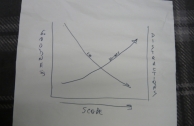
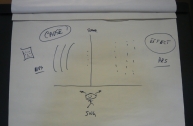
The Music Category was delighted to welcome current Category Specialist Jim Kahlke, who as well as all the usual virtues you see in people who take on this mantle, has a happy knack for drawing pictures of ideas. So I thought I’d share a couple of them that have resonance beyond the specificities of barbershop judging. I’m pretty sure that both sets of ideas were attributed to other members of the category (Roger Payne and Kathy Greason respectively, if I recall), but I’m calling them Jimbob’s here because it’s his drawings we’re looking at.

Choirs and Democracy

magentawinFurther to my comments earlier this week on power-sharing in a choral context: between scheduling that post and its publication, I had an interesting experience with Magenta that got us all reflecting about these questions in more detail. The occasion was the Adult Choirs class at the Worcester Festival, and the experience was receiving feedback from the adjudicator, David Lawson. (The photo will give you a hint, in case you are interested, as to how we got on.)

The specific comment that David made was (and this is as near verbatim as I can get – I neglected to make a note until later):

I always say to my choir at school that, ‘Choir is not a democracy’. Now, I saw that you had somebody giving the notes and bringing you in, but I wondered whether you are actually getting dangerously near a democracy?

The big joke within Magenta afterwards was that everybody’s immediate instinct was to look at me to see what the correct answer was.

On the Primary and Secondary Effects of Rehearsal Methods

I have remarked before how rehearsal methods one chooses for a specific reason often have secondary effects that you didn’t necessarily anticipate but that nonetheless chime with your overall aims and ethos. One particular instance of this rule of benign unintended consequences we have experienced in Magenta is the practice of having all members out front in turn to coach the group as a whole.

The routine is this: each person stands out front, and we sing a section of maybe 16-20 bars to them. They feed back (a) on something that they liked about the performance and (b) on something that they would like to see added or improved. (If they accidentally tell us something that was wrong, we rephrase in positive terms; so for example if we’re told the start was a bit tentative and insipid, the instruction becomes, 'Please perform the start with more confidence and clarity'.). We then sing the same section again to give them what they wanted. We then go on to sing the next section to the next person.

Posture, Attitude and the Autonomic Nervous System

Do you ever get a hunch that certain ideas or phenomena are related, but you’re not sure of the nature of the relationship? The purpose of this post is to mull on three different ideas to see why they seem to resonate together so well. It may be simply that they share a similar structure (which always makes mapping things onto each other both easy and tempting), but I think their connections may turn out to be stronger than that.

I’ll outline each first, then tease out the relationships between them.

ABCD Conductor Training Day

The Coton Centre in Tamworth is a wonderful venue for musical training eventsThe Coton Centre in Tamworth is a wonderful venue for musical training eventsSaturday saw the Association of British Choral Directors Midlands Region hold a training day for conductors. There were two streams, one led by Sue Hollingworth for school teachers about the Sing Up programme, and I was presenting on the other for choral directors.

It was the second event at which I have been presenting recently where the group of participants felt almost perfectly constituted to offer a real range and breadth of perspectives. We had directors of church choirs, community choirs, long-established choral societies, male voice choirs and youth choirs. We had all ages from school-age to senior. We had beginners, seasoned directors, and those with some experience looking to build on their work so far.

...found this helpful?

I provide this content free of charge, because I like to be helpful. If you have found it useful, you may wish to make a donation to the causes I support to say thank you.


Archive by date

Syndicate content