
Coaching Conductorless Rubato

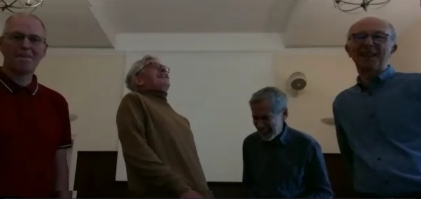
The main benefit of online coaching: good screenshots of people laughingThe main benefit of online coaching: good screenshots of people laughing

I spent a rewarding afternoon on Thursday with a quartet who had contacted me for advice about how to manage rubato in an ensemble without a conductor. They formed from within a choir they all sing in so are accustomed to using the visual signals from their musical director to coordinate them, and were finding the lack of this external guide one of the major challenges of singing in quartet, especially in music that isn’t strictly in rhythm.

We split the process into two distinct stages: how to rehearse, and how to perform. The former is where the group develops a shared understanding of musical shape and a shared awareness of each other in the ensemble. The latter needs a repertoire of interpersonal cues to transfer those understandings into the performance situation.

Miscellaneous Thoughts on Vocables

This post arises from a collection of random notes in my Thinking Book and conversations on social media, none of which were substantial enough to make a post of their own, but would if bundled together. So, a bit of a miscellany, but at least a themed one.

Vocables are the nonsense/neutral sysllables we use in a cappella to create accompanying textures. They are sometimes intended to evoke instrumental textures explicitly, but they’re often simply about creating a distinctive expressive profile for a song and providing expressive variety over the course of the musical narrative.

Change vocable when you change pattern

One of the things that takes up an awful lot of rehearsal time when working with human beings, especially human beings who work in idioms that involve memorising music, is handling the bits where a pattern changes. You set up a riff, and then some pesky musical detail like how the melody goes or a change in chord means you have to mess with it – in the process, messing with the singers’ heads just as they’d got settled into their stride.

On Trouble-shooting in Practice and Rehearsal

I mentioned a while back that I’ve been practising the piano regularly in 2022 for the first time in years. This has entailed a combination of reconnecting with past pianistic past skills gone rusty and developing skills in new ways that weren’t accessible to the younger me at previous stages in my musical journey.

It has also involved a parallel process of rediscovery and development in regard to the processes of practising. Last time I worked in any kind of structured way at the piano (as opposed to just playing the instrument every so often…and less and less often over the years…) I didn’t have the years of teaching and rehearsal experience I do now. So, I’m finding all kinds of interesting interchanges between my life helping others grow as musicians and my own efforts to re-establish some level of competence.

On the Wisdom of Undine Smith Moore

walkerhillI have been reading Helen Walker-Hill’s splendid book From Spirituals to Symphonies: African-American Women Composers and their Music, and learning many enlightening things. Today I’m going to share with you some of the thoughts of Undine Smith Moore. I already knew I liked her music, but it turns out that she was also a percipient cultural critic with many insights to share.

Two particular thoughts leapt out from Walker-Hill’s account, both to do with the way those who are excluded from a dominant culture can have a clearer view of that culture than those who are inside it. I’ll quote at length because the clarity of expression is part of what makes her clarity of thought so palpable:

The Lime Pickle Principle

My original plan was to use the actual label for today’s concept as my title, and use lime pickle as my primary metaphor to illustrate it. But after staring at a blank screen for a while I realised I don’t actually have a clear, precise label for this idea, so I’m going with Lime Pickle Principle as my title until I get this figured out. A label may emerge during the act of writing of course, but I won’t be bothered by then to go back and change the title and first paragraph so you’re stuck with the metaphorical title for now.

This concept emerged whilst coaching Amersham A Cappella the other week. The song we were working on is a really interesting one, in which the persona is incredibly vivid and engaging, but there are occasional whiffs that they might actually have a bit of a nasty streak to them. And this bit of friction in the sympathy is part of what makes it so engaging: you really want to identify with them, but also you’re a bit uncomfortable when you do.

On Metaphors and Messing with People’s Heads

[On executing a vocable using the syllable ‘ha’ without making the tone breathy]

Don’t let the h invade the vowel. You want to keep the salt on the edge of the margharita glass, not put it into the drink.

The coaching process produces all kinds of metaphors for different aspects of musical performance, many of them emerging spontaneously from the needs of the moment. One of the things, I am told, that Amersham A Cappella appreciate about my coaching is the vividness and idiosyncrasy of some of the metaphors that pop out during the process. One of the things I appreciate about working with them is knowing that they’ll go with whatever wild imagery comes to hand: not needing to filter insights for sensibleness on the way gives an incredible sense of creative freedom.

Exploring Arrangement Choices with Amersham A Cappella

A topically sports-themed warm-upA topically sports-themed warm-up

Tuesday evening took me back to coach my friends at Amersham A Cappella on some of the new songs they’re working on. They seem to be in a particularly up-for-it and life-affirming mood right now in their repertoire choices, with anthems from Erasure and Aretha Franklin on the go as well as an exuberant number I arranged some years ago for Finesse quartet.

A recurrent theme of the evening was exploring the impact of who the music was arranged for on the arrangement choices. A fair number of the chorus had known Finesse, either in terms of hearing them perform, or knowing the individual singers personally. So it was useful for them to know that this was one of those charts where I’d been thinking not of the tenor, lead, bari and bass lines, but of the Helen, Beth, Tanya and Nicky lines. Handing round the melody wasn’t just a matter of seeing where the range fit best, but also of thinking about the personality and vocal colour of those individuals.

The Cultural Politics of Authenticity

Social media is often a colossal waste of time, but you get an interesting and nuanced discussion on a subject that is both practical and principled just often enough to make it worth keeping looking at it. I’d like to reflect on one such discussion I saw amongst a group of choral directors recently, as the various contributions teased out a range of perspectives on a thorny question.

The question was whether a British choir should assume Puerto Rican accents to sing songs from West Side Story. A director had asked their choir to do so, but some of the choir’s younger members were ‘appalled’ at what they considered a racist request.

Some of the participants in the discussion supported the conductor on the grounds of musical authenticity. It would sound silly in choral British accents, they contended, and recommended reference to the original film as a guide. (Though I’d think reference to the recent remake would be a better guide from this point of view, since it uses actual Latinx actors for those roles, not white actors in brown-face as many are in the 1961 version.)

...found this helpful?

I provide this content free of charge, because I like to be helpful. If you have found it useful, you may wish to make a donation to the causes I support to say thank you.


Archive by date

Syndicate content