
Choosing Relatable Music

It’s not hard to get people to agree that it’s good to perform music that an audience will be able to relate to. It’s not always the highest priority - some people might think first about beauty, or about spiritual depth - but a dialogue about musical values will usually find the common ground between these more abstract qualities and the importance of a meaningful experience that connects performers and listeners.

This does not necessarily make it easy, of course, to reach agreement as to what constitutes ‘relatable’ music.

I had two conversations in quick succession recently that brought this into relief for me. In both cases the issue arose through differences of opinion between a choir director and some of their singers, though in rather different genre contexts. It gradually emerged that people were using the concept of ‘relatable’ music as a code for ‘not that stuff you want to do that I don’t like’.

Self-Deprecation and the Conductor

These thoughts initially arose in response to working with the participants on the Association of British Choral Directors’ Initial Conducting Course at the weekend. But as I mulled on them on my way home I realised that, while there are ways in which that social context amplified the issue, it’s a general one for choral directors in real life. When I describe the form of behaviour I mean, you’ll recognise it.

So, this is what I was seeing: a conductor stands up in front of the singers they are about to direct, and in various verbal and non-verbal ways, they put themselves and their work down. They soften and lower their posture, and drop their gaze. They describe the activity they’re about to lead as a ‘little’ warm-up or ‘a bit of an exercise’. They express hope that it will work, and apologise for tiny stumbles that would otherwise not have been noticed.

(I say ‘they’; it may be ‘we’. I’m going to have to watch myself here.)

Goal-Setting in Action

Posting an article about goal-setting this week wasn’t purely a decision related to the New Year. I was also thinking about a session I was due to facilitate with the Music Team of Cleeve Harmony on Thursday. The chorus has just celebrated its 3rd birthday (indeed, they celebrated this week with a very well-attended Open Night), and are shifting from the new-chorus-doing-everything-as-novices phase into the now-we’re-established-and-have-a-sense-of-group-identity-how-do-we-want-to-develop? phase. Whilst they still feel they have plenty to learn, they have some solid experience and successes under their belts on which to build.

(I’m not sure that you ever really stop feeling that there’s more to learn, but being able to look back and measure the distance you’ve travelled since you knew even less does build a corporate sense of stability. And whatever the previous experience people come in with, the ensemble needs to do that journey together to generate that shared history.)

Multi-Dimensional Goal-Setting

This is something I’ve talked about in my Make Your Nerves Work For You sessions at various events over the years, but I think it’s worth mulling over in a wider context too. Goal-setting is not just about managing performance psychology, after all. (Though I think this wider context does help draw attention to the way that things we think of as specifically performance-related issues are often rooted far deeper in our whole relationship with our praxis.) And first blog-post of the New Year feels like a good moment to share these thoughts.

So, this is a nice simple formulation, borrowed from sports psychology. It distinguishes 3 different types of goal:

Plus de Musicologie en Paris

Quick plug for this publication from members of CReIMQuick plug for this publication from members of CReIMHaving unloaded my initial impressions of the experience of attending a conference in my second language for the first time, I also wanted to have a brief mull over some of the things I found myself taking notes about from other people’s papers. Feminist musicology is a relatively recent addition to the landscape of francophone musicology, I gather, and is still getting itself established.

(Whereas in anglophone musicology, it was fully respectable by the mid-1990s. This means that when you say anything particularly feminist these days, some helpful soul can breezily dismiss your point with the assertion that we did all this 20 years ago so there can really be nothing left to complain about. I am thinking of a particular exchange from a couple of months ago when I write that, but in a fit of discretion I am not going to say who it was between. Just because I am angry with someone doesn’t mean I have to be gratuitously rude about them online.)

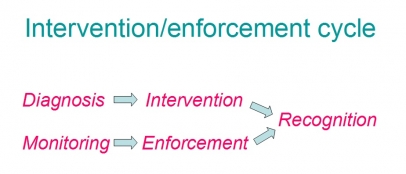
The Intervention and Enforcement Cycles, Part 3

Having outlined the basic framework, and analysed some of our commonest errors, it is time to finish with some extra advice on how to use the Intervention and Enforcement Cycles to best effect.

  • Positive framing: “Do this!”

    Don’t breathe at the end of this phrase
    Join these two phrases together

    These are identical in intent as interventions (or, indeed, enforcements), but the second is a far easier instruction to follow. Likewise:

    Less volume in this section
    More hushed here

    If we always frame our instructions in terms of things to add to the performance, rather than things to take away, it keeps people focused on what you are achieving together. This means that not only is it more emotionally satisfying (succeeding at something feels better than merely not failing at something), but it gives your singers more control over their developing skills to think about them in terms of actions they can do rather than mistakes to avoid.

The Intervention and Enforcement Cycles, Part 2

intervention

Having looked in my post last week about what the Intervention and Enforcement Cycles are and how they work, it’s time to have a look at how to use them more efficiently and effectively. So, here are some of the commonest forms of inefficiency in rehearsal that dilute our effectiveness.

Musicologie en Paris

Université Paris 8Université Paris 8

I’m going to interrupt my series on rehearsal techniques to stop and boggle for a bit about my trip last week to France for my first ever experience of a conference conducted mostly in my second language. I had been invited as one of two keynote speakers to a conference entitled Music and Gender: Current State of Research,* and although conference was genuinely international, with speakers from Brazil, Italy, Spain and Greece as well as France, England and Ireland, we were the only two to present in English.

Now, I have read a good deal of French over the years, including some reasonably dense music theory, so I wasn’t entirely unprepared for this. But most of my actual live interactions in the language have been of the ‘two beers and a cheese sandwich’ type, so in other ways this was something of a baptism of fire. I will have some thoughts to share on matters of music and gender arising from the papers and their discussion in due course, but my most immediate response is to want to reflect on what I learned about language, learning and communication from the adventure.

...found this helpful?

I provide this content free of charge, because I like to be helpful. If you have found it useful, you may wish to make a donation to the causes I support to say thank you.


Archive by date

Syndicate content